
What changes when a caregiver moves beyond learning about dementia and begins to understand what living with cognitive change might feel like?
That question is at the heart of Dementia Live®, AGE-u-cate’s immersive dementia education experience. Sagora Senior Living is using the program to strengthen staff education, deepen caregiver empathy and extend dementia awareness into the communities it serves.
According to a recent Senior Housing News article, Sagora introduced Dementia Live® within its Pathways memory care program. The organization is training new team members each week while also offering educational experiences for families, first responders, businesses and members of the public.
This investment represents more than the launch of another memory care staff training program. It demonstrates how experiential dementia education can become a catalyst for better communication, stronger care coordination and more dementia-friendly communities.
Why Dementia Training for Senior Living Staff Must Go Beyond the Basics
Traditional dementia education often concentrates on diagnoses, symptoms, safety procedures and compliance requirements. That information is essential—but facts alone do not always prepare a care partner for the emotional complexity of a real interaction.
What happens when a resident refuses assistance? How should a caregiver respond when someone asks the same question repeatedly? What might be behind a person’s distress during bathing, dressing or dining?
Without a deeper understanding of the person’s experience, these moments may be labeled as resistance, aggression or difficult behavior. Empathy-based dementia training invites caregivers to consider another possibility: The person may be frightened, overwhelmed, physically uncomfortable or unable to interpret what is happening around them.
That change in perspective can transform a care response. Instead of correcting, the caregiver may validate. Instead of rushing, the caregiver may slow down. Instead of focusing only on stopping a behavioral expression, the caregiver can look for the unmet need being communicated.
This is where person-centered dementia care education begins—not with a checklist, but with curiosity, connection and a willingness to enter another person’s reality.
How Immersive Dementia Simulation Training Builds Empathy
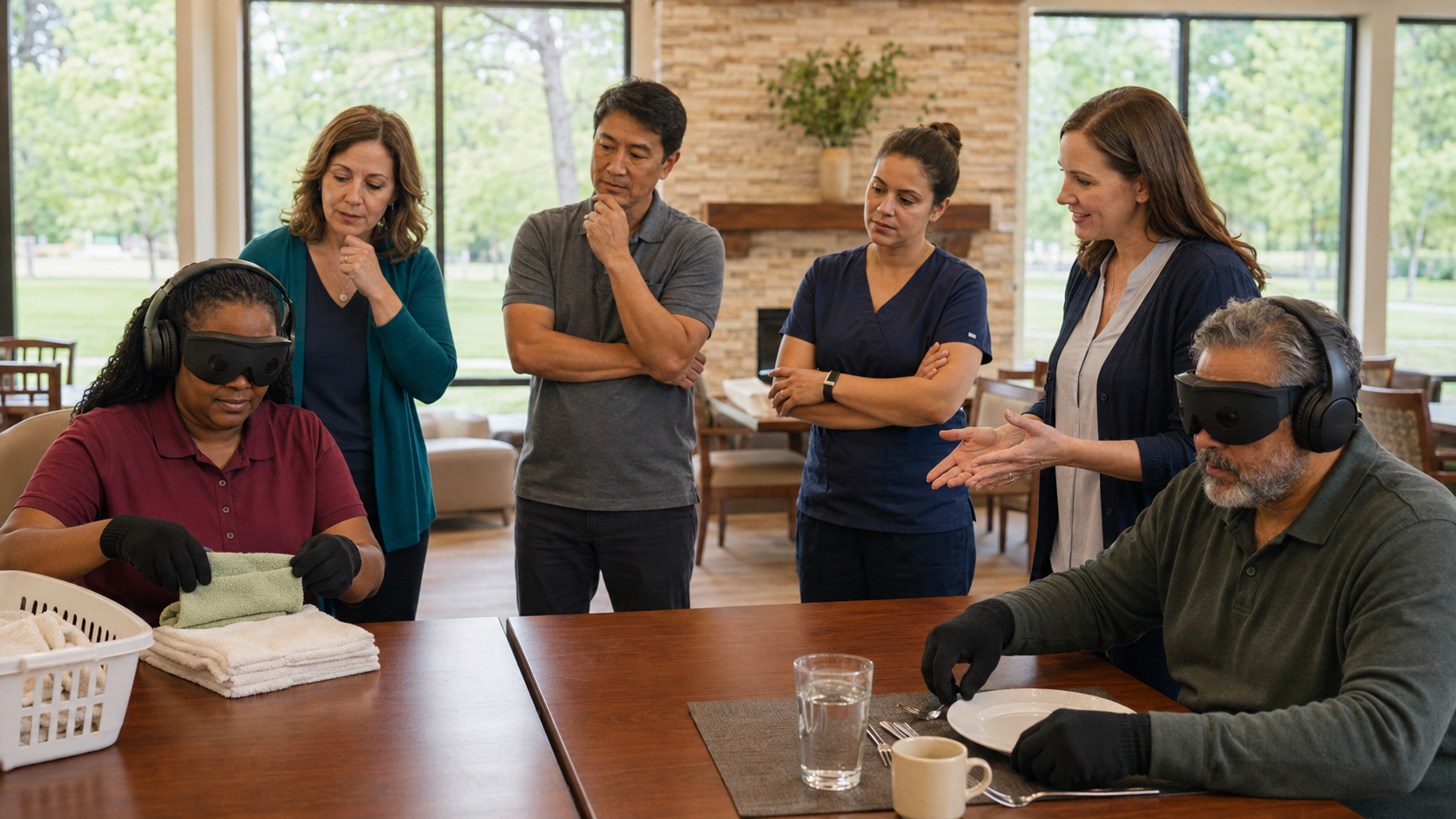
Dementia Live® is an experiential learning program developed by AGE-u-cate. It is designed to help participants gain an inside-out understanding of cognitive and sensory changes associated with dementia.
During the experience, participants complete everyday tasks while navigating simulated cognitive, sensory and physical challenges. The experience may create feelings of confusion, frustration, isolation or being overwhelmed. These moments often lead to powerful “aha” insights.
A participant may suddenly understand why too many instructions can increase distress. Another may recognize how background noise can make communication difficult. Someone else may discover how quickly a seemingly simple task becomes frustrating when sensory information is altered.
The goal is not to suggest that a short experience can fully replicate any individual’s life with dementia. Dementia is complex, and every person’s journey is different. Instead, the program creates a meaningful point of reference—one that helps participants examine assumptions and respond with greater empathy.
Empathy is not merely a soft skill. It is a practical care competency that can influence communication, trust, engagement and quality of life.
From the Training Room to the Memory Care Floor
The value of experiential dementia education for caregivers is measured by what happens after the experience. When care partners return to the care environment with a new perspective, small but important changes can begin to appear:
- Instructions may become shorter and easier to follow.
- Care partners may allow more time for a response.
- Teams may reduce unnecessary noise and environmental distractions.
- Staff may begin interpreting behavioral expressions as communication.
- Interactions may focus more on retained abilities than perceived losses.
- Employees across departments may share observations more consistently.
These changes support improving care coordination in memory care because every team member becomes part of the care experience. A dining employee may notice that a resident becomes anxious when the room is crowded. A housekeeper may observe a meaningful change in the person’s routine. A receptionist may recognize that a visitor needs additional guidance when communicating with a loved one.
High-quality memory care is not created by one department. It develops when the entire organization understands dementia and shares responsibility for preserving dignity, connection and well-being. Sagora’s commitment to recurring training helps make that understanding part of its care culture—not simply a one-time educational event.
Supporting Families Through Dementia Education
Families also benefit from dementia education for families and caregivers. A diagnosis of Alzheimer’s disease or another form of dementia changes relationships. Family members may feel grief, fear, frustration and uncertainty as communication patterns and familiar roles begin to shift.
Experiential dementia education can help families see challenging moments through a different lens. A loved one who repeats a story is not trying to frustrate them. A person who no longer recognizes a familiar place may be responding to an environment that feels genuinely unfamiliar. Someone who refuses an activity may need reassurance, a simpler invitation or a different approach.
This understanding does not remove the challenges of caregiving. It can, however, reduce blame and help families develop more compassionate, effective ways to connect. By making education available to residents’ families and the wider public, Sagora is extending person-centered dementia support beyond the walls of its memory care neighborhoods.
Why First Responders and Local Businesses Need Dementia Training
Dementia is not only a senior living issue. It is a community issue. People living with dementia visit grocery stores, banks, restaurants, medical offices, libraries and places of worship. They may interact with police officers, firefighters and emergency medical personnel during moments of uncertainty or crisis.
A first responder without dementia education may interpret confusion as refusal to cooperate. A retail employee may not recognize that a customer is disoriented. A banking professional may miss signs that an older adult is vulnerable to fraud or financial exploitation.
Dementia training for first responders and community professionals can improve recognition, communication and de-escalation. It can help participants approach calmly, use simple language, allow more processing time, reduce distractions and recognize that distress may be related to cognitive change.
Because Dementia Live® is designed to be mobile, Sagora can bring the experience to outside groups. This creates an opportunity to transform dementia awareness into practical, community-wide action.
How to Build a Dementia-Friendly Community Through Education
The number of people living with dementia is expected to grow significantly in the coming decades. Preparing for that future will require more than expanding memory care capacity. We must also build communities in which people living with cognitive change can remain recognized, respected and supported.
A dementia-friendly community is one in which businesses understand how to assist a confused customer, first responders know how to de-escalate a stressful encounter and families can access trusted education before a crisis occurs.
Senior living organizations are uniquely positioned to lead this work. They already possess expertise, relationships and practical knowledge that can benefit the broader public. By sharing Dementia Live® with employees, families and community partners, Sagora is demonstrating what it means to think beyond resident-centered care toward a more comprehensive, senior-focused mission.
Empathy Is the Beginning of Better Dementia Care
Technology, clinical knowledge and operational systems will continue to shape the future of memory care. Yet the quality of a person’s daily experience will still depend heavily on human interactions.
Does the caregiver pause before reacting? Does the first responder recognize fear beneath confusion? Does the family member connect with the person who is present today?
Experiential dementia education helps create that essential pause between what we observe and how we respond. In that pause, judgment can give way to curiosity. Frustration can become understanding. A task can become an opportunity for meaningful human connection.
Sagora Senior Living’s investment in Dementia Live® shows how empathy-based dementia education can strengthen a workforce, support families and engage an entire community.
At AGE-u-cate, we believe transformative dementia care begins when people are equipped to see the person—not simply the diagnosis. Through immersive learning and practical education, we can help caregivers and communities move from awareness to empathy, and from empathy to action.
CALL TO ACTION Ready to strengthen dementia understanding across your organization or community? Explore Dementia Live® and AGE-u-cate’s empathy-based dementia education programs to learn how experiential training can help your team build confidence, improve communication and deliver more person-centered support.