Lessons I've learned from grandmama Mildred are endless, but I'll finish with sharing a few connected to her final days. These two stories, while representative of her final days, also speak to the culmination of Mildred's life: unconditional love, endless laughter and unwavering faith.
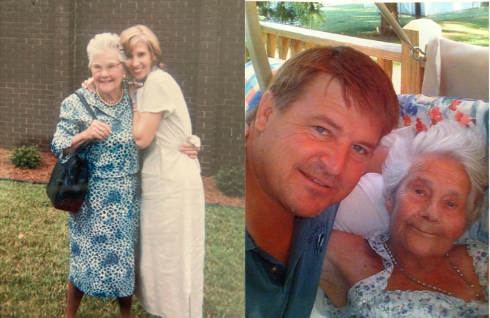
- Be ok with just being compassionately present. Towards the end of my grandmothers life, my family was all gathered at my aunt's house where my grandmother lived her last days. In those final days, grandmama Mildred was in and out of awareness that we were there. On this day, we had taken her outside to lay in a swing - the sun was shining and there was a wonderful breeze with birds singing. She loved being in nature! My mom was helping her eat ice cream and trying to get grandmama to engage with us. “Is it good, mama?” “Here’s some ice cream” “Is it good?” is what my mama kept saying, over and over. After a bit my grandmother all of the sudden opened her eyes, looked at my mom and said in a snarky tone, “Is it good? Is it good?”. In her always hilarious way, she was telling my mama to shut up and let her enjoy the ice cream! Not that my mom was trying to be annoying - we were all so desperate to make sure grandmama knew we were there. After that moment, we knew she could always feel (and hear!) us!
Lesson learned: sometimes just sitting quietly is enough. The person can feel your presence through touch and a thoughtful environment set-up.
- Look for the signs, they often come at unexpected times. On the day grandmama Mildred took her last breath, my family was gathered around her bed. It was a hospital bed we rented and we had it pushed up to the king size bed in the room. On the king bed was me, my mom, several of my aunts and my 2 sisters. We were playing hymns and music that my grandmama loved. On Eagle's Wings, a familiar Catholic hymn was playing and as we were all singing the chorus - "And he will raise you up on eagle's wings...", my grandmother began to raise up. It was a chaotic few moments until we realized that my aunt was laying on the hospital bed remote! We all burst into hysterics and knew that was grandmama Mildred, playing one last joke on everyone. And bringing laughter into the room as she always did.
Lesson learned: The time will come to say goodbye. Even in that moment, find joyful ways to connect and cope.
Dying and death is often viewed as a scary and sad turn of events. And while losing someone we love is sad, the truth is that we're all going to die at some point. There, I said it! A recent post I ran across on LinkedIn shared the concept of maraṇasati, meaning mindfulness of death. It's a Buddhist meditation practice that often includes incorporating various visualization and contemplation techniques focused on the nature of death. From what I could gather, the intent is to bring more awareness to your present moment and encourage you to live life as if there is no tomorrow. No regrets! And if you practice Christianity, you believe that with death also comes eternal life. There is comfort in knowing the rest of your days will be spent with Jesus and others who have gone before you. For my family, we take comfort in the latter. And that is something that my grandmama Mildred instilled in all of us. And I'm lucky that those roots continue to run deep through my mama. If you're reading this, mama, grandmama would be so proud of how you continue to guide our family in strong faith!
I'm also intrigued by maranasati and look forward to researching that more. How do you cope and find comfort in times of loss? There is no right way, and sharing may help others! Be sure to leave a comment. And, if you'd like more information on death and dying, check out a previous blog or reach out to me.
For the article I saw on LinkedIn about maranasati, click here. And if you need a "lift" today, here's the song, On Eagle's Wings!
To view the previous post introducing my grandmother and our family's journey caring for her, check it out here.