Preparing the Next Generation for Dementia Care
Tomorrow’s dementia care workforce is already sitting in classrooms, completing clinical rotations, learning alongside other disciplines, and beginning careers in health and supportive care.
The question is not whether these future professionals will encounter dementia. It is whether they will enter the workforce prepared to recognize cognitive and sensory changes, communicate in a person-centered way, include families as partners, and protect dignity and choice in everyday interactions.
Geriatrics Workforce Enhancement Programs are uniquely positioned to close that gap. By connecting academic institutions, clinical training sites, community organizations, students, professionals, and family caregivers, GWEPs can make dementia education part of workforce preparation rather than something people receive only after a difficult encounter.
Dementia Education Is Workforce Preparation
The need for a dementia-capable workforce will grow alongside the population it serves. By 2030, every member of the baby boom generation will be at least 65, and roughly one in five Americans will be of retirement age. HRSA notes that this shift will require a robust, well-trained long-term services and supports workforce. At the same time, HRSA projects shortages in key areas of care by 2038, including primary care and geriatrics, with especially significant access challenges in nonmetropolitan communities.
Demand is also expanding across the direct-care workforce. The U.S. Bureau of Labor Statistics projects employment of home health and personal care aides to grow 18% from 2025 to 2035, with approximately 760,500 openings each year on average. Many of the people filling these roles will support older adults living with cognitive change, whether or not dementia appears in their job title.
That makes dementia education a workforce issue—not a specialty elective. Nurses, physicians, therapists, social workers, pharmacists, direct-care professionals, community health workers, first responders, drivers, dining teams, and family caregivers may all influence how a person living with dementia experiences care.
Why Education Should Begin Early
Waiting until a professional is already overwhelmed by the pace and demands of practice makes person-centered habits harder to build. Early education gives students and trainees space to reflect, ask questions, examine assumptions, and practice approaches before those patterns become fixed.
It also helps future professionals understand that dementia care is not limited to memory. Cognitive and sensory changes can affect how a person processes instructions, interprets an environment, communicates a need, makes a choice, or responds to unfamiliar routines. A task that appears simple to the caregiver may feel confusing, rushed, or overwhelming to the person receiving support.
When this understanding is introduced across disciplines, students begin their careers with a shared language. A nurse, occupational therapist, social worker, pharmacist, and direct-care professional may have different responsibilities, but each can learn to slow the pace, simplify directions, reduce unnecessary stimulation, offer meaningful choices, and consider what the person may be communicating.
Experiential Learning Makes the Lesson More Memorable
Traditional education can explain dementia clinically. Experiential learning helps participants examine how their own communication, pace, environment, and expectations may affect an interaction.
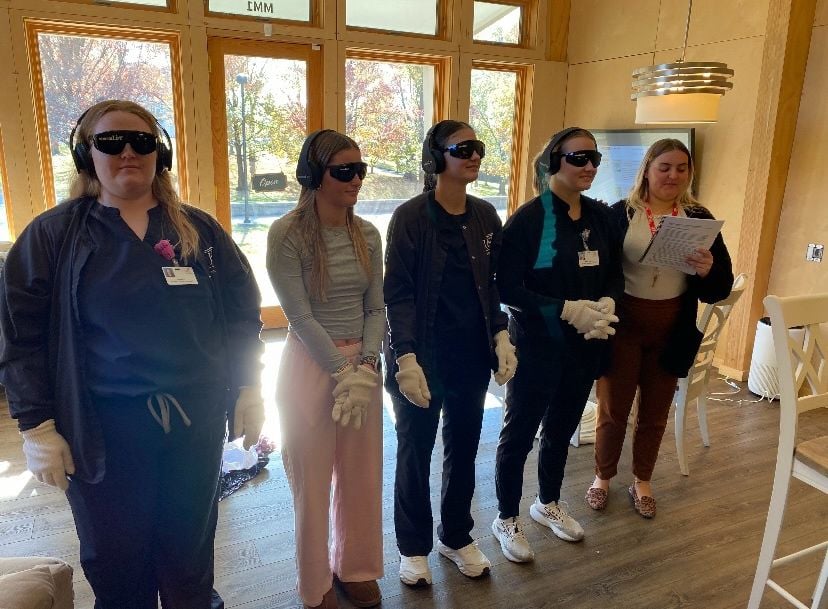
Dementia Live® offers participants a brief, structured glimpse into selected cognitive and sensory challenges that a person living with dementia may experience. The experience is followed by guided reflection and an empowerment session that connects insight to practical action. It is not intended to reproduce every person’s experience of dementia or suggest that dementia is defined only by difficulty. Its value comes from helping participants question assumptions and decide what they can do differently.
Research supports the role of simulation-based education in preparing future professionals. A study involving 65 undergraduate nursing students reported a significant increase in empathy after Dementia Live. A later study involving 125 pre-licensure nursing and graduate occupational therapy students found significant empathy gains immediately after the experience and at six weeks. The qualitative findings also showed that students were thinking more deeply about empathy, power, and how care is delivered.
The lesson is not simply “dementia is hard.” The more useful lesson is that caregiver choices matter. The way a professional approaches, explains, waits, listens, redirects, or offers support can change an interaction.
The Benefits Extend Beyond the Learner
For the workforce. Early dementia education can build readiness before professionals enter practice. Experiential learning gives students a common reference point for discussing communication, person-centered care, teamwork, and the 4Ms of an Age-Friendly Health System—especially What Matters and Mentation. When education continues through onboarding, huddles, and continuing education, it becomes part of how an organization works rather than a one-time event.
For people living with dementia. Better-prepared professionals are more likely to pause before labeling an interaction as resistance or noncompliance. They can look for unmet needs, environmental barriers, communication differences, personal preferences, strengths, and abilities. That shift supports dignity, participation, connection, and individualized care.
For families and care partners. Families often help teams understand routines, history, preferences, and what matters most to the person. When professionals have stronger dementia knowledge, families spend less time explaining the basics and can participate more fully as partners. Community-facing education can also give families practical approaches they can use at home and language for describing what support they need.
GWEPs Can Turn One Experience Into a Regional Strategy
HRSA describes the purpose of GWEP as educating and training health care and supportive care workforces through collaboration with community partners, while maximizing patient and family engagement and integrating geriatrics with primary care. In 2024, HRSA awarded more than $206 million to 42 GWEP grantees. The program’s guidance also requires an annual allocation for Alzheimer’s disease and related dementias education and training, including trainee support. That requirement is not a vendor budget; it is a signal that dementia education is a core workforce priority.
The strongest opportunity is to treat that education as infrastructure. Instead of relying on a single annual presentation, GWEPs can prepare local educators and Coaches who can deliver recurring learning across academic programs, clinical sites, nursing homes, community organizations, and family networks.
AGE-u-cate partners are already demonstrating this reach. The University of Southern Indiana GWEP incorporates Dementia Live into nursing and interdisciplinary education and supports delivery through regional partners. In a recent mixed-role feedback group, 26 of 28 respondents reported greater confidence in adjusting their approach after the experience. The University of Texas at El Paso GWEP offers Dementia Live to professionals, students, caregivers, and families, including sessions in Spanish. These examples illustrate how one program can be adapted to the people, languages, and settings of a region. The USI feedback reflects perceived learning from respondents and should not be treated as evidence of long-term care outcomes.
Building a Sustainable Education Pathway
A practical GWEP strategy can connect education across the learner’s journey:
Introduce dementia understanding in pre-licensure and interdisciplinary education.
Reinforce person-centered approaches during clinical training and field experiences.
Prepare local Coaches and faculty who can deliver education repeatedly.
Extend learning into onboarding, team huddles, continuing education, and quality improvement.
Offer education to families, direct-care workers, community partners, and underserved populations.
Measure confidence and intended changes immediately, then follow up on reported actions and observed practice over time.
Dementia Live can create the moment of recognition. Compassionate Touch® can help translate that understanding into practical ways to communicate, offer comfort, and connect through skilled touch and compassionate presence, always within the person’s preferences and consent, program guidance, organizational policy, and the care plan.
Together, these programs can help GWEPs move from awareness to repeatable practice—linking student education, workforce development, family engagement, and community impact.
Preparing Today for the Care Needs of Tomorrow
The future dementia workforce cannot be built only by recruiting more people. It must also be built by preparing people differently.
When students encounter dementia education early, they have time to develop empathy, communication habits, and person-centered thinking before they enter demanding care environments. When GWEPs carry that learning across disciplines and into community settings, the impact reaches beyond the learner—to the person living with dementia, the family supporting them, and the organizations working to provide better care.
We invite GWEP leaders, educators, clinical partners, and community organizations to make experiential dementia education part of the workforce pathway. The next generation is preparing now. The understanding, confidence, and skills they carry forward will shape dementia care for years to come.
Explore the AGE-u-cate GWEP Industry Brief and learn how Dementia Live® and Compassionate Touch® can support a repeatable education strategy across academic, clinical, and community partners.
Sources
• HRSA Geriatrics Workforce Enhancement Program funding opportunity
• HRSA GWEP frequently asked questions
• HRSA health workforce projections
• U.S. Census Bureau demographic turning points
• U.S. Bureau of Labor Statistics home health and personal care aides outlook
• Kimzey et al. Effects of Simulation on Nursing Students Dementia Knowledge and Empathy
• Parkman et al. Enhancing Empathy through Dementia Simulation
• University of Southern Indiana Dementia Live Simulation