Think about the last training experience that stayed with you.
What made it memorable? Perhaps you tried something unfamiliar, worked through a challenge, or had a conversation that changed your perspective. You left with something you could use—and a reason to use it.
Now consider your dementia care training.
When the session ends and the next shift begins, what travels with your team? Can they recall what they learned? Can they demonstrate a new skill? Do they approach the person in front of them with greater curiosity, patience, and understanding?
These are the questions that make training meaningful.
For senior living, memory care, assisted living, and home care organizations, experiential dementia care training offers a powerful opportunity to connect knowledge with empathy and everyday practice.
Why Experiential Learning Matters in Dementia Care
Experiential learning invites people to participate actively, reflect on what happened, and apply what they discovered.
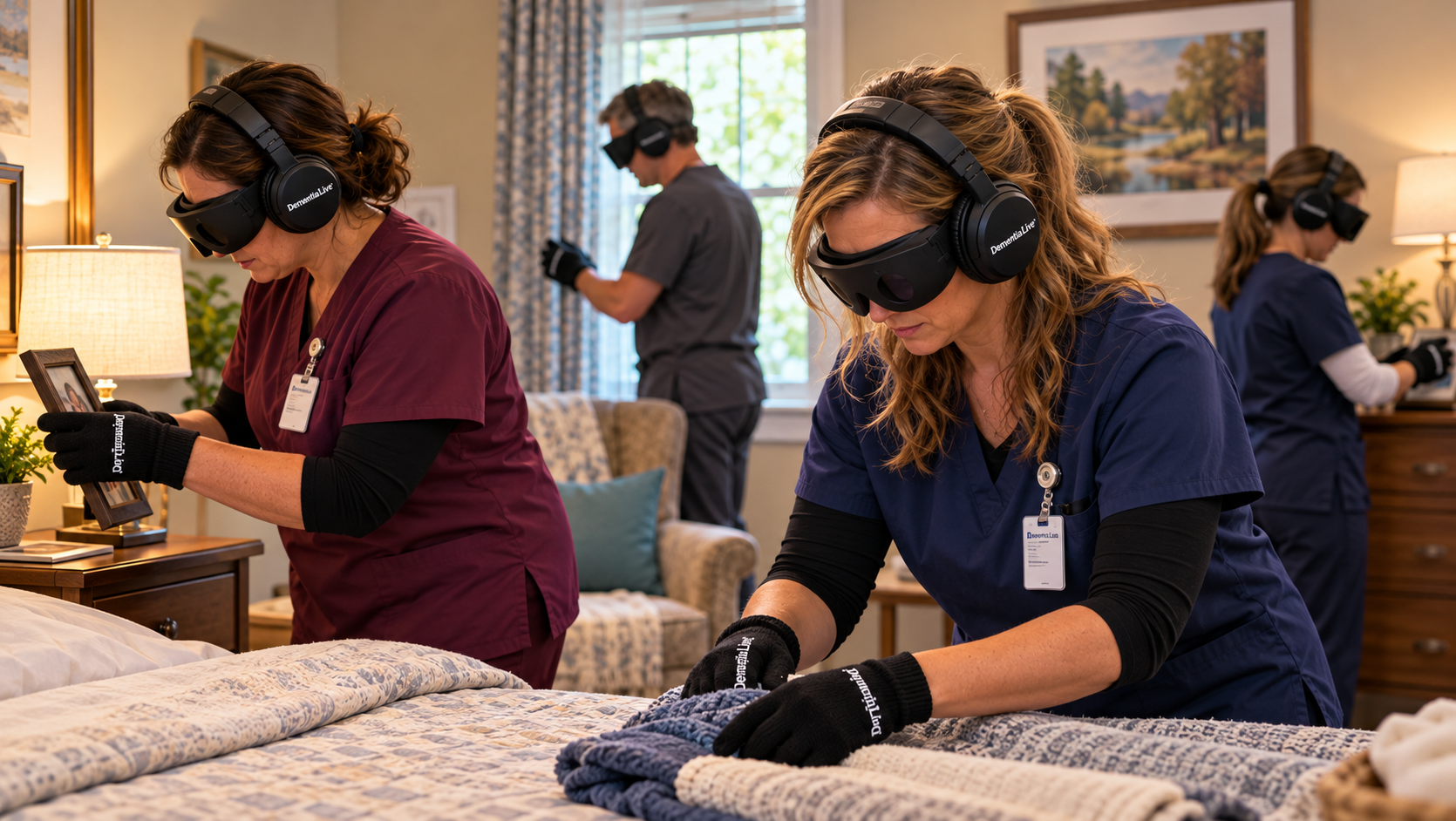
In dementia care education, that might include a guided immersive experience, a communication exercise, a realistic scenario, or practicing a new approach with a colleague.
The learning becomes personal.
A caregiver may understand the instruction to “give someone more time.” An activity that reveals how difficult it can be to process competing information can give that instruction deeper meaning.
Suddenly, a pause feels purposeful. A quieter environment makes sense. A calm approach becomes something worth practicing.
No exercise can fully reproduce another person’s experience of dementia. Thoughtfully facilitated experiences can, however, prompt valuable questions:
What might this person be experiencing? What am I asking them to process? How could I make this interaction easier?
Those questions create space for more compassionate care.
At the Utah Health Care Association Conference, Kristy Russell, Kate Nederostek, Tanya Macdonald, and Jamie Naverette facilitated four Dementia Live sessions as part of a Memory Care Lab. One participant wrote, “I want to do this with our staff!! It made me understand how our residents feel.” Another shared, “Excellent!! Very effective. More CNA’s need this class!” These immediate reactions suggest that the experience gave participants something they wanted to carry into their workplaces.
Memorable Dementia Training Connects Experience With Practice
An engaging activity can capture attention. Lasting learning needs somewhere to go.
The strongest training experiences connect four elements:
Experience. Give participants a meaningful opportunity to engage with a challenge.
Reflection. Help them examine what they noticed, felt, and assumed.
Practice. Translate that insight into a specific caregiving skill.
Reinforcement. Revisit the skill through coaching, discussion, and repeated use.
This is where retention becomes an intentional part of training design.
Learning research supports the value of retrieving information from memory instead of simply reviewing it again. Asking team members to explain an approach, recall a lesson, or work through a fresh scenario gives them an opportunity to strengthen what they remember. Research published in PNAS illustrates the benefits of retrieval practice.
For dementia care teams, reinforcement can fit into everyday routines. A brief team huddle might revisit one communication skill. A supervisor might invite a caregiver to share how they applied a lesson. A follow-up exercise might ask staff to demonstrate what they would do in a familiar situation.
A memorable experience starts the learning. Continued practice helps make it available when it matters.
Empathy Becomes More Powerful When Caregivers Can Act on It
Empathy deserves a practical place in dementia care training.
It can influence the pace of an interaction, the words a caregiver chooses, and the willingness to pause and reconsider an approach.
Skills-based dementia training gives caregivers opportunities to practice those choices. For example:
- Offering one clear direction at a time.
- Allowing space for a response.
- Recognizing and acknowledging emotion.
- Adjusting tone, pace, and body language.
- Considering how the surrounding environment may affect an interaction.
Imagine a training scenario in which a person hesitates during a familiar activity.
Participants can explore how they might respond, practice their wording, and receive feedback. They can consider what additional information they need and how their own approach might change.
The facilitator can then ask: What did you notice when you slowed down? What helped the interaction feel more respectful? What would you try next?
That process turns a broad intention—“be more empathetic”—into something caregivers can demonstrate.
Healthcare simulation provides opportunities to practice knowledge, skills, and behaviors before applying them in care settings. The Agency for Healthcare Research and Quality identifies this practice opportunity as a central strength of simulation.
Yes, Dementia Care Training Can Be Fun to Deliver
There is room for energy, discovery, connection, and enjoyment in education about a serious subject.
Think of the satisfaction of watching a quiet participant contribute an insight. The energy of colleagues solving a challenge together. The confidence someone gains when a new communication approach begins to feel natural.
These moments make training rewarding for facilitators, too.
Interactive dementia training gives educators opportunities to listen, coach, ask thoughtful questions, and respond to the people in the room. Participants bring their experience into the learning, creating conversations that a presentation alone may never uncover.
Enjoyment belongs in the teamwork, discovery, and skill-building, with respect for people living with dementia guiding every activity.
A supportive learning environment also gives caregivers room to ask questions, acknowledge uncertainty, and try again. That is valuable space for developing both competence and confidence.
Make the Debrief Count
After an experiential activity, give participants time to connect the experience to their work.
A thoughtful debrief might ask:
What surprised you?
What assumptions did you notice?
What helped you feel supported?
What will you do differently in your next care interaction?
Then make the next step concrete. Ask each participant to identify one skill to practice and decide when the team will revisit it.
This gives a meaningful experience a practical destination.
What Will Your Team Carry Into the Next Shift?
Training attendance tells you who was in the room. Demonstration, reflection, and follow-up help reveal what they can use.
Look for the caregiver who explains why they changed their approach. The colleague who models a skill for a teammate. The staff member who pauses to consider another perspective.
Those are meaningful signs of learning taking hold.
AGE-u-cate’s Dementia Live® offers an experiential starting point for this work, with resources designed to connect the experience to practical caregiver empowerment. Explore Dementia Live® and its training resources to consider how it could support your team’s learning.
Your next dementia care training can be an experience people remember, enjoy participating in, and draw upon in their daily work.
Give caregivers something meaningful to experience. Help them reflect. Let them practice. Keep the learning alive.
Because the most important moment in training may come later—when a caregiver remembers, pauses, and responds with greater understanding.